
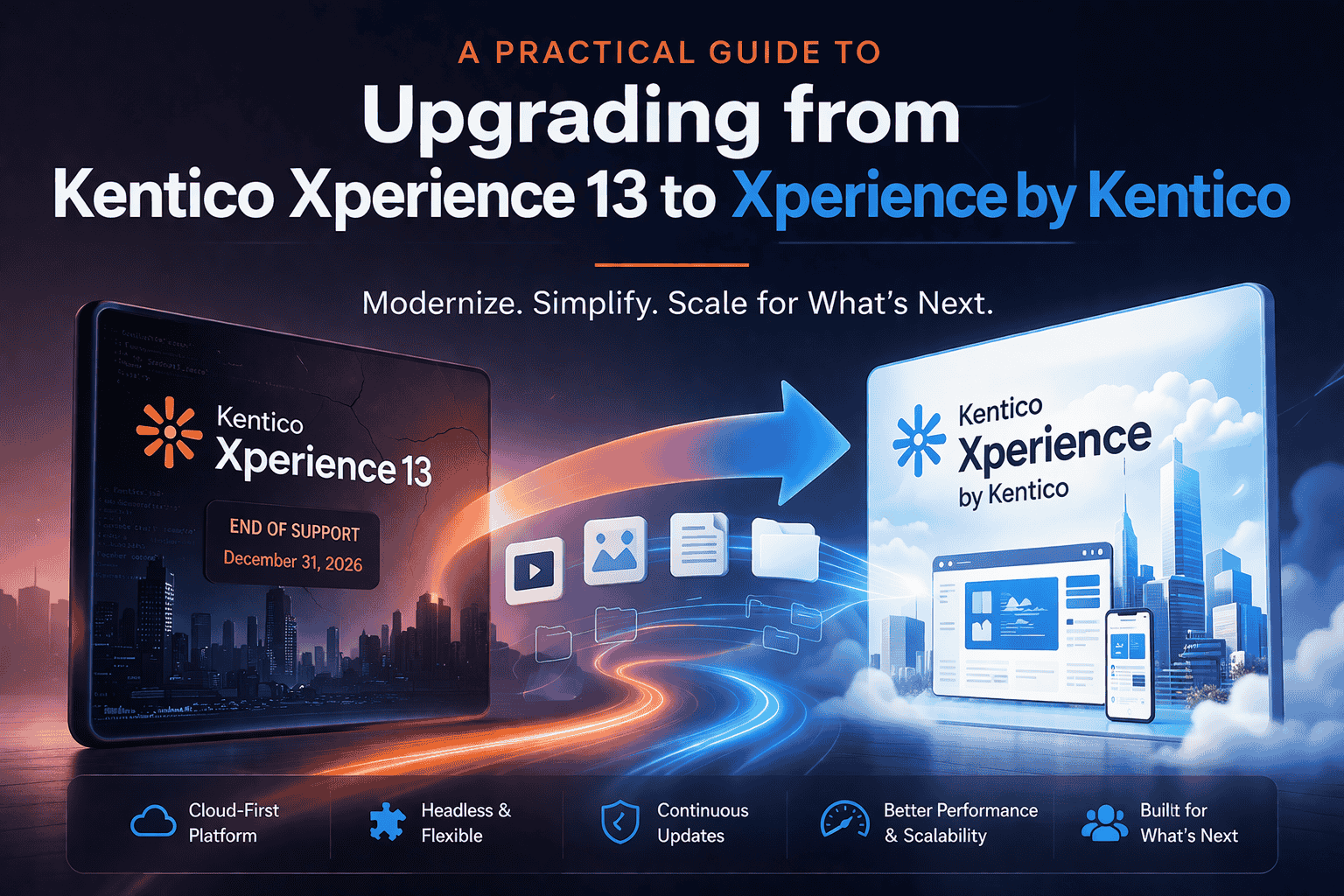
If you've been running Kentico Xperience 13 for the past few years, you've likely built something stable and reliable. Your team understands the platform, your workflows are well established, and your integrations are doing their job. Everything works and that’s exactly why change can feel unnecessary.
Then comes the conversation around “end of support.”
December 31, 2026. That’s when Kentico will officially end support for Xperience 13. For many organizations, the first reaction is usually: “Do we really need to worry about this now?”
The short answer is yes but not because of urgency alone. This moment is less about risk and more about opportunity. It’s a chance to rethink your platform, modernize your architecture, and prepare your digital ecosystem for the next phase of growth.
At K2America, we’ve guided multiple organizations through this transition. And what we’ve consistently seen is this: the companies that approach this proactively get far more value than those who treat it as a last-minute upgrade.
The Reality of End of Support: What It Actually Means
When Kentico ends support for Xperience 13, your platform doesn’t suddenly stop working but the dynamics around it start to change.
Security updates will no longer be provided. Any new vulnerabilities will need to be handled internally, increasing both risk and effort over time.
Integrations will become harder to maintain. External systems evolve continuously. As APIs and authentication methods change, older platforms struggle to keep up, leading to frequent fixes and workarounds.
Compliance risks increase. For organizations operating in regulated environments, running unsupported software can quickly become a concern during audits and security reviews.
Talent challenges start to appear. Developers naturally gravitate toward modern platforms. Maintaining legacy systems can impact both hiring and long term team engagement.
The key takeaway is this: the impact is gradual, but very real. Over time, stability, efficiency, and innovation all begin to decline.
The Cost of Waiting (And Why Timing Matters)
One pattern we’ve consistently observed is that organizations that delay their upgrade tend to face more challenges not because the migration itself becomes impossible, but because it becomes reactive instead of strategic.
When upgrades are rushed, decisions are made under pressure. There’s less time for proper planning, testing, and optimization. This often leads to rework, inefficiencies, and missed opportunities to improve the platform.
There’s also a broader market dynamic at play. As more organizations approach the same deadline, demand for expertise increases. Timelines become tighter, and flexibility reduces.
Perhaps more importantly, staying on an older platform means your team continues investing time in maintenance instead of innovation. Over time, that lost momentum becomes a hidden cost that’s easy to overlook.
Xperience by Kentico: More Than Just an Upgrade
One of the biggest misconceptions is treating Xperience by Kentico as simply a newer version of Xperience 13. In reality, it represents a significant architectural shift.
The platform is built with a hybrid headless approach, allowing content to be managed centrally and delivered across multiple channels websites, mobile apps, APIs, and more.
Some key differences include:
- Content Hub: A centralized model for managing reusable content across channels
- Cloud-Managed Infrastructure: Reduced operational overhead and improved scalability
- Continuous Updates: Smaller, incremental improvements instead of large version upgrades
- Modern .NET Foundation: Cleaner architecture and improved developer experience
- Flexible Delivery: Support for both traditional and headless implementations
While the shift may feel significant initially, most teams adapt quickly especially when the transition is planned thoughtfully.
AI Capabilities in Xperience by Kentico
One of the most important advancements in Xperience by Kentico is its focus on AI powered features. These capabilities are designed to improve both content management and user experience without adding complexity.
Kentico’s evolving AI ecosystem (AIRA) helps teams work smarter by reducing manual effort and providing intelligent insights.
- Smarter Content Creation: Generate content ideas, summaries, and variations quickly
- Intelligent Content Organization: Better tagging and structuring for large content sets
- Personalized Experiences: Deliver dynamic content based on user behavior
- Workflow Automation: Automate repetitive tasks and improve efficiency
- Data-Driven Insights: Make informed decisions based on user engagement patterns
These features don’t replace human creativity they enhance it. Teams can focus more on strategy while AI handles repetitive and data-heavy tasks.
This is where Xperience by Kentico stands out not just as a CMS, but as a smarter digital experience platform.
Start with a Real Audit
Before planning any migration, it’s essential to understand your current system in detail. This step is often underestimated, but it sets the foundation for everything that follows.
Take time to evaluate:
- Existing content structures and hierarchy
- Custom modules and code dependencies
- Third party integrations
- Unused or outdated content
- Workflow complexity and usage patterns
This process often reveals opportunities to simplify and optimize, rather than simply replicate what already exists.
Data Preparation: The Foundation of a Smooth Migration
Content cleanup is rarely exciting, but it has a direct impact on the success of your migration.
Over time, most platforms accumulate outdated content, duplicate entries, and unused assets. Migrating everything as-is only transfers complexity to the new system.
A more effective approach is to:
- Remove unused or outdated content
- Consolidate duplicate data
- Clean up media libraries
- Validate data consistency
- Rethink content models for better flexibility
This step simplifies migration and creates a cleaner, more maintainable platform moving forward.
The Migration Approach: A Structured Path
While every project is unique, a structured approach helps reduce risk and improve outcomes.
Assessment and Planning
Understand the current system, define priorities, and create a realistic roadmap.
Content Model Design
Redesign content structures to take advantage of modern capabilities.
Environment Setup
Prepare the new platform and validate integrations early.
Data Migration
Move content in phases, ensuring accuracy and consistency.
Testing and Validation
Verify functionality, performance, and SEO elements before launch.
Deployment and Support
Launch with confidence and provide ongoing monitoring and optimization.
Common Challenges (And How to Avoid Them)
- Content complexity: Simplify and restructure where possible
- Custom code: Refactor using modern patterns
- Integrations: Validate and adapt early
- SEO impact: Plan URL mapping and redirects carefully
- Team readiness: Invest in training and onboarding
Addressing these proactively makes the transition significantly smoother.
Thinking Beyond Cost: The Bigger Picture
While migration requires investment, it’s important to look beyond immediate effort and consider long term value.
Upgrading to Xperience by Kentico typically results in:
- Improved performance and scalability
- Reduced maintenance overhead
- Faster feature development
- Better alignment with modern digital strategies
In contrast, delaying the upgrade often leads to increased complexity and reduced efficiency over time.
Our Approach at K2America
We approach upgrades as transformation initiatives, not just technical migrations.
- We start with business goals, not just technical requirements
- We design architecture for long term scalability
- We follow an iterative, low risk migration approach
- We work closely with your team throughout the process
- We focus on delivering measurable business value
This ensures the platform is not only upgraded but also improved in meaningful ways.
Final Thoughts
Upgrading from Kentico Xperience 13 to Xperience by Kentico is not just about keeping up with technology it’s about preparing your digital platform for what comes next.
Organizations that start early and approach this thoughtfully are able to reduce risk, improve efficiency, and unlock new capabilities.
December 31, 2026 is a milestone but it doesn’t have to be a pressure point.
With the right planning and approach, it becomes an opportunity to modernize, simplify, and move forward with confidence.

 by Sukhveer Kaur