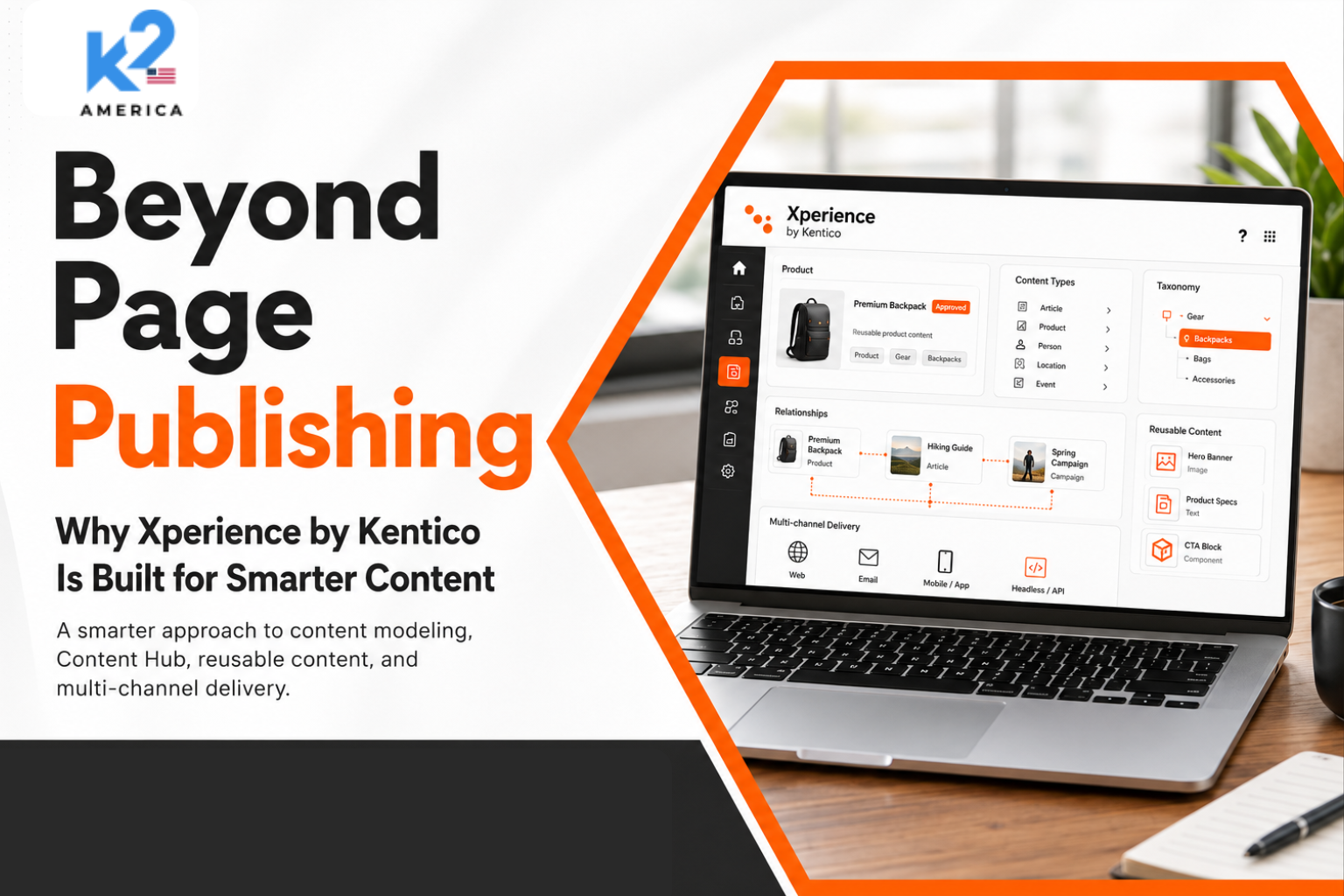
When businesses start rethinking their CMS, the conversation usually begins with content.
Not design. Not plugins. Not even development.
Content.
Because that is where teams feel the pressure first.
Pages take too long to update. The same information gets copied into multiple places. Marketing wants to move faster, but content is scattered across the site. And once the business wants to use that same content in email, landing pages, or other digital channels, things become even harder to manage.
That is one of the biggest reasons Xperience by Kentico is getting attention.
It gives businesses a better way to handle content from the start. Not just publish it, but structure it properly, organize it clearly, and reuse it in a way that actually makes day-to-day work easier.
The real value starts with content modeling
A lot of platforms can help you create pages.
That is not the hard part.
The hard part is building content in a way that still makes sense six months later, when the website has grown, new campaigns have been launched, and different teams all need to work with the same information.
That is where content modeling matters.
Content modeling is really about planning your content properly. It is deciding what kind of content you need, how it should be structured, what fields belong to it, and how different pieces of content should connect to one another.
It may sound like a technical concept, but it has a very practical impact.
If content is not modeled well, teams usually end up doing everything the hard way. They rewrite similar content over and over. Updates become manual. Consistency starts slipping. And every new request feels like extra work.
Xperience by Kentico handles this in a more thoughtful way.
Instead of treating content as something that only lives inside individual pages, it encourages a more structured approach. That makes it easier to manage content properly, not just for one page, but across the whole digital experience.
Why this feels better than many other technologies
A lot of other platforms work perfectly fine when the website is simple.
If the goal is just to publish a few pages, add blog posts, and keep things basic, many tools can handle that.
But businesses usually do not stay basic for long.
As soon as content grows, the cracks start to show. Different layouts need different content. Teams want to reuse messaging across campaigns. Product, service, and resource content need to stay consistent. And suddenly, what looked simple starts becoming messy behind the scenes.
That is where Xperience by Kentico feels different.
It is better suited to businesses that want content to be managed like a real business asset, not just page copy sitting in random places.
That difference matters.
Because once content is structured properly, the whole system becomes easier to work with. Editors know where things belong. Updates are faster. Reuse becomes easier. And the business is not constantly fixing the same issue in five different places.
Content Hub is one of the biggest reasons it stands out
If there is one feature that really changes the way content is managed in Xperience by Kentico, it is Content Hub.
Content Hub gives teams one central place to work with reusable content. And that sounds simple, but in real-world content operations, it makes a huge difference.
In many businesses, content gets trapped inside pages. A message gets written for one page, copied to another, adjusted slightly for a campaign, and then copied again somewhere else. It works for a while, but over time it creates clutter and inconsistency.
Content Hub helps solve that.
Instead of treating every page as its own little island, it allows businesses to manage content in a more connected way. Content can be created as reusable items and then used wherever it is needed.
That could be:
- service-related content
- product details
- author information
- FAQs
- campaign messaging
- testimonials
- supporting content used in more than one place
That approach saves time, but more importantly, it gives teams more control.
When one important detail changes, it is much easier to update it properly. When marketers need to launch something quickly, they are not starting from zero. And when the business grows, content does not become unmanageable as quickly as it often does in less structured setups.
Taxonomy and relationships make content more useful
This is another area where Xperience by Kentico feels stronger.
Content is rarely isolated. Most of the time, it connects to something else.
A blog may relate to a service. A case study may connect to an industry. A landing page may need supporting testimonials. A resource may belong under a topic, category, or audience type.
These relationships matter more than people realize.
They make content easier to organize, easier to surface, and easier to reuse in the right context.
The same goes for taxonomy.
When content is grouped and categorized properly, teams can manage it more cleanly and users can experience it in a more meaningful way. It is easier to filter, easier to connect, and easier to scale.
That is part of what makes Xperience by Kentico attractive from a content point of view. It is not just helping teams publish. It is helping them build a cleaner foundation behind the scenes.
It also makes more sense for multi-channel content
Most businesses are not managing content for just one website anymore.
They are thinking about websites, landing pages, email, campaigns, portals, apps, and sometimes headless delivery too.
That changes what a business actually needs from a CMS.
It is no longer enough to ask, “Can this platform publish a page?”
The better question is, “Can this platform help us manage content once and use it in smarter ways across multiple channels?”
That is where Xperience by Kentico has a clear advantage.
Because the content is structured and reusable, it fits much better into a modern digital setup. Businesses are in a stronger position to use content across channels without rebuilding everything from scratch every time.
That saves effort, reduces inconsistency, and gives teams more flexibility as their content needs evolve.
Why businesses end up choosing Xperience by Kentico
At a practical level, businesses choose Xperience by Kentico because it helps them solve real content problems.
- a better way to structure content
- less duplication
- easier updates
- more consistency across channels
- stronger governance as content grows
- a platform that supports both marketing needs and long-term content planning
And that is really the key point.
Xperience by Kentico is not only useful because it helps teams publish content. Plenty of tools can do that.
Its real strength is that it helps businesses manage content in a smarter, more scalable way.
Final thoughts
The reason many businesses move toward Xperience by Kentico comes down to this: content gets complicated faster than most teams expect.
At the beginning, almost any platform can feel manageable.
But as the business grows, content grows with it. More teams get involved. More channels appear. More reuse is needed. More structure becomes necessary.
That is when a platform built around stronger content modeling and a central system like Content Hub starts to make a real difference.
It gives businesses a cleaner way to work, not just today, but as their digital needs become more complex.
And that is why Xperience by Kentico stands out. It helps businesses move beyond simple page management and build a content foundation that is easier to manage, easier to scale, and far more useful in the long run.