
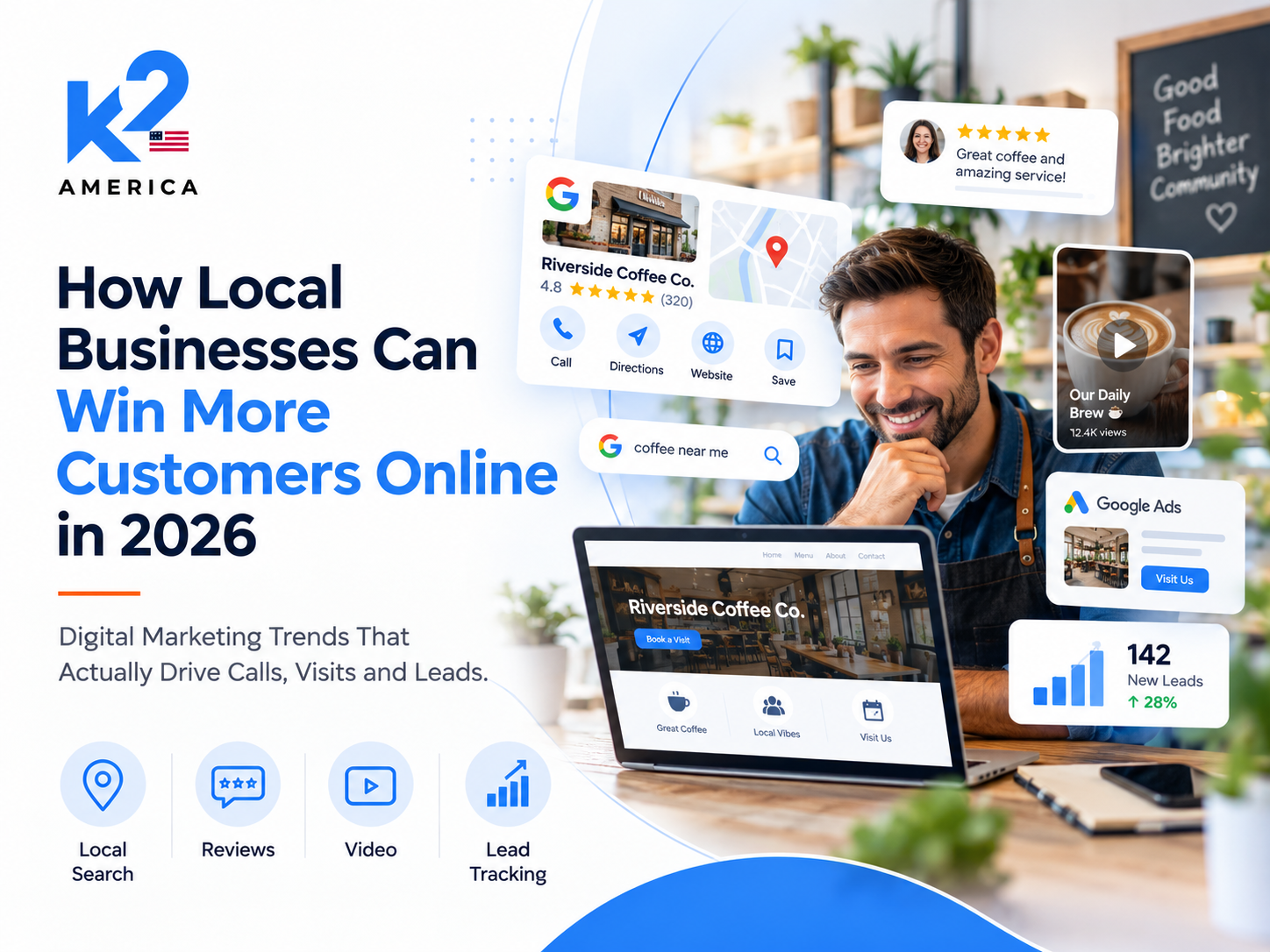
The 2026 local marketing trends that drive calls, leads and revenue
Local marketing is no longer just about ranking first on Google. It is about earning the call when a customer is ready to choose.
A potential customer might discover your business on Google Maps, check recent reviews, watch a short video, ask an AI assistant for recommendations, visit your website and then decide whether to contact you. If your business looks inconsistent, inactive or hard to trust at any point in that journey, you can lose the lead before you ever know it existed.
For business owners, the impact is immediate: better local visibility can create more qualified enquiries, stronger trust can improve conversion, and better tracking can show which marketing channels are actually producing revenue. The goal in 2026 is not to be everywhere. It is to show up in the places that influence a buying decision and make the next step easy.
- BE FOUND - Search + AI
- BUILD TRUST - Reviews + proof
- CONVERT - Website + calls
- MEASURE - Leads + revenue
1. Local search now includes AI, but your website still matters
Google Search and Maps are still central to local discovery, but customers are increasingly adding AI tools to the mix. BrightLocal's March 2026 consumer research found that 45% of consumers had used AI tools for local business recommendations in the previous year, up from 6% the year before.
That does not mean people are blindly accepting the first AI recommendation. Another BrightLocal study found that only 18% of people using AI during a local search felt ready to contact the recommended business immediately. Most continued researching through Google, websites, reviews or other channels before making a decision.
The newest data also reinforces the value of your own website. In a September 2026 study covering 200,000 local AI searches, BrightLocal found that business websites represented 93% of the unique domains used as AI sources and accounted for 42% of citations.
For a local business, the takeaway is practical: make it easy for search engines, AI tools and customers to understand exactly what you do, where you work and why you are credible. A clear service page with real examples, FAQs and accurate business details is more useful than a vague page written only to repeat a keyword.
Why this matters: Customers may discover you in more places, but they still need enough proof to choose you. Strong business information and a useful website increase the chances of being discovered and trusted.
Sources: BrightLocal: AI recommendations, Mar 2026 | BrightLocal: Local search behavior | BrightLocal: 200k local AI searches, Sep 2026
2. Treat your Google Business Profile like a second storefront
For many local searches, customers see your Google Business Profile before they see your website. That means outdated hours, weak photos, missing services or unanswered reviews can affect the buying decision before someone ever reaches your site.
Google says local results are mainly based on relevance, distance and prominence. Complete and accurate business information helps Google understand when your business is relevant, while reviews, links and overall prominence can influence how visible you are.
Think about an HVAC company competing for an 'AC repair near me' search. One profile has old photos, limited service details and no recent review activity. Another has current hours, recent installation photos, detailed services and thoughtful review responses. Even if both companies are technically qualified, the second business gives the customer more reasons to call.
Why this matters: Your Business Profile is not just an SEO asset. It is a conversion page. Keeping it current can improve both visibility and the confidence needed to generate calls, direction requests and enquiries.
Sources: Google Business Profile Help: local ranking
3. Recent reviews are sales proof, not just reputation
A large review count looks impressive, but customers are paying more attention to how recent those reviews are and whether the business responds like a real person.
BrightLocal's 2026 research found that 31% of consumers would ignore a business rated below 4.5 stars, while 74% said they mainly care about reviews from the previous 90 days. The message for business owners is simple: review generation cannot be a once a year campaign.
Build the request into the customer journey. A dental practice can send a short review link after an appointment. A contractor can ask once the job is signed off. A restaurant can make it easy to leave feedback after a visit. Timing matters because customers are more likely to respond while the experience is still fresh.
Responses matter too. A generic 'Thanks for your review' adds very little. A reply that mentions the service, acknowledges the customer's experience and sounds human gives future customers another reason to trust the business.
Why this matters: Fresh, credible reviews reduce uncertainty. That can improve the odds that a person who finds your business actually becomes a caller, visitor or booked customer.
Sources: BrightLocal: Local Consumer Review Survey 2026 | BrightLocal: 2026 review strategy
4. Create local content that answers real buying questions
Local SEO becomes weak when every city page says the same thing with only the location name changed. Customers do not need another page that simply says 'Roofing Services in Richmond.' They need useful information that helps them make a decision.
A roofing company could publish 'What Richmond Homeowners Should Check After a Major Storm' or show a recent roof replacement with photos, the problem, the solution and the outcome. A remodeling company could document a kitchen renovation in North Vancouver rather than repeating 'kitchen renovation near me' throughout a page.
This kind of content does three jobs at once. It gives Google more context about the services and areas you genuinely serve, gives AI tools stronger information to reference, and gives potential customers evidence that you have solved problems like theirs before.
Why this matters: Specific local content attracts better informed prospects and gives them a reason to trust your expertise before they contact you.
Sources: Google: relevance, distance and prominence | BrightLocal: local AI visibility study
5. Use short video to show the business behind the listing
Local businesses have an advantage with video because useful content is already happening every day. A landscaper can show a transformation. A dentist can answer a common patient question. A contractor can explain why one renovation costs more than another. A restaurant can show the dish people keep ordering.
HubSpot's 2026 marketing research found that short form video delivered the highest reported ROI among media formats, with 48.6% of marketers ranking it among their top three. HubSpot also reported that 76% of marketers believe authentic content performs better than highly produced content.
That is good news for small and local businesses. You do not need an expensive production setup. A clear 30 to 60 second answer to a real customer question can often feel more useful and trustworthy than a polished brand video.
Why this matters: Video helps customers see your expertise, your people and your work before they call. That can shorten the trust building process and make the eventual enquiry warmer.
Sources: HubSpot: 2026 State of Marketing | HubSpot: Future of Social Media 2026
6. Run paid search for buying intent, not just traffic
Paid search gets expensive when a business tries to advertise every service to everyone. The better approach is to focus budget on searches that suggest the person is close to taking action.
Compare 'What is a stairlift?' with 'stairlift installation near me,' or 'types of quartz countertops' with 'quartz countertop supplier near me.' The second search in each example is much closer to a purchase decision.
Build campaigns around your highest value services, locations and actions such as requesting a quote, booking an appointment or calling. Then review search terms regularly and exclude irrelevant traffic. A smaller number of qualified visits is often worth far more than a large number of cheap clicks.
Why this matters: The goal of local advertising is not to win the traffic report. It is to turn ad spend into qualified enquiries and profitable customers.
7. Make the website finish the sa
Customers may discover you through Maps, AI, social media, reviews or an ad, but many will still visit your website before committing. This is where a surprising number of businesses lose otherwise good leads.
Within a few seconds, a visitor should understand what you do, where you operate, why they should trust you and what to do next. Real project photos, recent reviews, service details, clear contact options and a simple quote or booking process usually matter more than clever design language.
For example, a basement renovation company will be more persuasive if it shows a real project, explains the homeowner's challenge, outlines the solution and shows the finished result than if it simply says it provides 'high quality renovations.'
Why this matters: Every extra question or point of friction gives a prospect a reason to keep comparing. A clear website helps convert the trust you built elsewhere into a real lead.
8. Measure customers and revenue, not just clicks
A report showing 2,800 clicks can look busy without telling you whether the marketing worked. Business owners need to know which channels are producing calls, forms, bookings, qualified leads and sales.
Imagine Campaign A generates 500 clicks, 30 enquiries and 3 customers. Campaign B generates 220 clicks, 18 enquiries and 9 customers. Campaign A wins on traffic and even leads, but Campaign B
produces three times as many customers. Without conversion and revenue tracking, you could easily put more budget into the wrong campaign.
At a minimum, track phone calls, forms, quote requests and bookings. Where possible, connect those leads to your CRM or sales records so you can see which campaigns are creating actual revenue, not just activity.
Why this matters: Better measurement turns marketing from an expense you hope is working into an investment you can improve with evidence.
What Local Digital Marketing Looks Like in 2026
The biggest change is not that one platform has replaced another. It is that customers now check more places before deciding who to trust.
A strong local strategy connects those touchpoints. Your Google Business Profile helps you get found. Recent reviews reduce risk. Useful local content and video prove expertise. Your website makes the next step easy. Paid search captures people who are ready to act. Tracking shows which efforts are actually producing customers.
If there is one principle to keep in mind, it is this: make your business easy to find, easy to trust and easy to contact.
That matters more than chasing every new marketing trend, and it is what turns digital visibility into calls, visits, leads and revenue.
A practical 90 day priority
Start with the customer journey you already have. Update your Google Business Profile and core service pages, put a consistent review request process in place, publish a few pieces of proof based content such as project examples or short videos, and make sure every meaningful call, form and booking is tracked. Once those foundations are working, expand into AI visibility and additional channels with a much clearer idea of what actually drives business.
Sources and Further Reading
- BrightLocal, Nearly Half of Consumers are Asking AI for Business Recommendations (March 2026)
- BrightLocal, Where Are Your Customers Really Searching? (2026)
- BrightLocal, What 200k Local AI Searches Tell Us (September 2026)
- BrightLocal, Local Consumer Review Survey 2026
- BrightLocal, How to Build a Review Strategy That Works in 2026
- Google Business Profile Help, Tips to Improve Your Local Ranking on Google
- HubSpot, 2026 State of Marketing
- HubSpot, The Future of Social Media in 2026

 by Rahul Kumawat